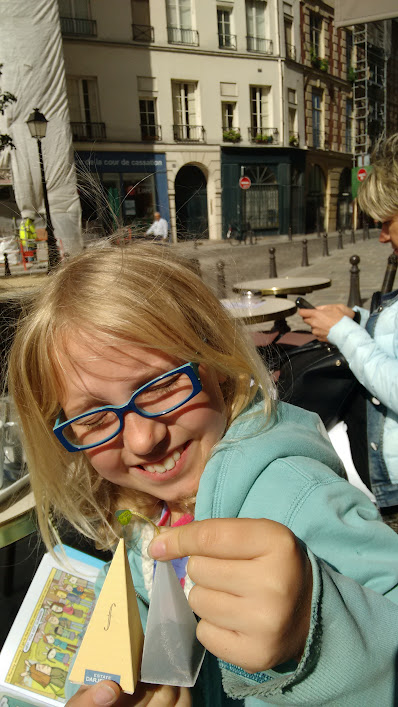
Yesterday was a lovely, lazy day full of serendipity. Our regular breakfast cafe had a broken coffee machine so we strolled on until we found La Rose de France on Place Dauphine and had a breakfast so splendid and beautifully presented that we fully expected it to be ridiculously expensive, but it came to less than ten Euros per head. I mean seriously, Julia’s pyramidal tea bags alone should have cost that much.
Then we visited Notre Dame, which was beautiful and creepy, and then we had ice cream from Berthillon as everyone had urged us to do and how very right you all were, and then we wandered through the Marais until we stumbled across Au Petit Versailles du Marais again, so we had lunch there and the baguettes brought tears to my eyes, so soft and sweet were they. We revisited the Centre Pompidou and went to the cat cafe and then Jeremy went to the Corbusier and Mona Hartoum exhibits while the children and I bought sandals and found ourselves passing La Dernier Bar avant la Fin du Monde, which Ada had strongly recommended, so we went in there as well.
It was all delicious and happy until we got back to the apartment and Liz texted me “Rach – are you ok -” and I had to sit down because nothing good ever starts that way.
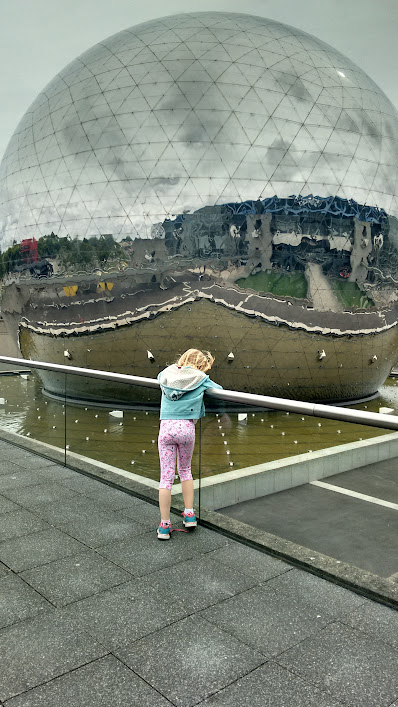
We braved the Metro (Jeremy deftly blocking a pickpocketing attempt) out to Parc de la Villette to visit the Cité des Sciences et l’Industrie, which according to Wikipedia is the biggest science museum in Europe. It is pretty big! We bought tickets to all the temporary exhibitions, which was a bit of a misstep because the permanent exhibitions were exquisite and we didn’t get to spend anywhere near enough time with them.
As we were touring the Argonaut, a decommissioned submarine, I got mail from the neuroscientist in London who is writing the case study about Dad’s blog. We had hoped to move Dad’s brain to a brain bank for further study but unfortunately this won’t be possible. The neuroscientist reassured us that although Dad’s brain has already been embalmed and used to train surgeons, the resulting anatomical report will still be very helpful in establishing the diagnosis of fronto-temporal dementia.
Dad used to take us to the Observatory and the Australian Museum and the Powerhouse and its precursor, the Museum of Applied Arts and Sciences, all the time. He took us to Taronga and Western Plains Zoo and Tidbinbilla and Parkes. His factory built fire control systems for the Collins Class submarine. He would have loved the Cité. I feel a space where grief should be. Proposed Site for Grief. What happened to Dad is so huge and terrible I can’t even get there yet. All I have is these tiny, inadequate glimmers of what he was. Of all that we have lost.
I rode Colin’s favorite horse this morning and it was incredible. That would normally be the high point of the day, but today was in no way a normal day.
First, marriage equality. I married Jeremy in 2000 because I had secure visa status in the US, and he didn’t. The fear of him being deported was untenable. It was the vulnerability of migration that opened my eyes to what marriage is; it is forcing the state to recognize your found family. That definition of marriage was the gift of the people we lost to AIDS, whose partners were sometimes barred from the deathbed. Legal marriage means that your love matters, that it must be taken into account.
It’s hard, maybe impossible to convey to my own children just how staggering it is that we are here; how many people fought and died for this.
And even that wasn’t the high point of the day. The murderer of the Charlston 9 wanted a race war, not the occasion of maybe the most profound and beautiful moment of Obama’s presidency.
Grace is the unlooked-for gift, the undeserved kindness, a green shoot growing in the desert. Amazing.
1. Yeah so that happened and it was awful. I ordered flowers for Milton’s funeral which made me mad and sad, not that I grudged him the flowers but that I was so angry with him for being dead. I think I also wanted to be at the funeral so that I could be with other people who knew him and could understand what his death meant. Jeremy met him a few times but didn’t know him well and otherwise I was alone with it, which always sucks and is boring.
2. Otherwise and weirdly I am feeling much better, having shaken off the last of the horrible Chicago cold and consequent lingering bronchitis and what was evidently some kind of post-viral malaise that plunged me back into the worst days of having an undiagnosed anxiety disorder in my teens and 20s. I gotta give myself credit for spending the last dozen years taking meds and getting enough exercise and sleep and healthy food, because given the opportunity to directly compare my current and former emotional states, it’s clear that in spite of all the, you know, wrenching grief, my baseline mood is way better than it used to be.
3. I am finally reading (listening in the car to) And the Band Played On, Randy Shilts’ beautifully furious book about the early years of the AIDS epidemic; uneasy stuff when you are well, let alone when you are paranoid and sick. Excellent narrative history turns you into the Doctor visiting a Fixed Point In Time: it is 1980 and I am standing in the Ice Palace on Fire Island at 1am, looking at all the gorgeous men on the dance floor, knowing that there is nothing I or anyone else can do to save them. I am so, so sorry.
4. Speaking of beautiful fury, the new Mad Max movie is an exquisitely-researched and historically accurate documentary about my childhood and it gives me life. I got properly into the spirit of it too, getting rear-ended hard on the way to the cinema, jumping out of poor banged-up Mercy of Kalr in the middle of Van Ness and screaming at the other driver and kicking his license plate. He was at fault like San Andreas, of course, so his insurance covers everything including the rental on the piece-of-garbage Chevy Sonic I am driving around while Mercy is at the body shop. Her name is Lieutenant Seivarden, and she self-identifies as a small war rig.
5. Last night I dreamed I checked into a hotel where I was shown to a suite that I had to share with strangers who invaded my personal space, and when I complained to the staff they made fun of my accent and lost my favourite jacket, and when I realized that I was in a dramatization of my own mundane fears and insecurities I decided I was probably dreaming and that if I was, I might as well see Mum, so I turned around and there she was, wearing red and orange and gold and looking radiantly well and laughing. So I hugged her a lot.
My poor sister must be so sick of giving me news she knows is going to ruin my day, week, month, but God knows it’s better than finding out from someone else. Milton had a heart attack on Friday. He collapsed at home and his wife Nic revived him, but he died before the ambulance got to the hospital.
I don’t remember meeting him; our friendship was of such long standing that the bulk of it pre-dates this blog. He was in kindergarten with my older brother, and I was in kindergarten with his younger brother and the kid who would become his stepbrother. In our teens his family washed up at the same church as mine for whatever reason. He was a youth leader there, although in retrospect it’s obvious he already had one foot out the door. He and his brother were blond, blue-eyed, square-jawed Australians who would have been almost boringly conventionally attractive if not for their obvious intelligence and the anarchic gleam of mischief in their eyes. (Also they were both short-arses, barely taller than me.)
He was the first of our little cohort to travel, and he did it properly: to Europe and Asia for more than a year, so that his name had become something of a legend by the time he showed up at church again, brown and glowing with a huge grin on his face. Other people glazed over at his stories (memorable quote from someone else at the time: “Why would anyone want to travel? God’s love is the same everywhere.”) But I wanted to see every photo, hear every anecdote. In retrospect it’s obvious I already had one foot out the door. It must have been around then that he started treating me as a pesky little sister and I him as another all-knowing big brother. We all had nicknames then: his was Stilt Man, maybe because of his height? (Mine was PL, short for Poor Little Rachel, baby sister to Big Sar, Big Man and Big Al.)
Travel became his focus for a while. He was working at the student travel agency in the Wentworth Building at Sydney Uni when he sold me my flight to Dublin in 1993. He was not long back from LA, where he’d gotten caught up in the riots. It sobered him a little: “I’m falling in love with Sydney all over again,” he said, and for months afterwards I looked at our hometown with new, more respectful eyes. He parlayed his travel agency experience into early Web jobs and we overlapped in San Francisco during the dot com boom. He had an apartment in North Beach and rode his bike over the Golden Gate Bridge to his job in Sausalito. Gotta hand it to him, the man had panache.
After he moved back, we met up at Petit Creme in Sydney a time or two on my visits home. He worked as an information architect at IBM, and he and his girlfriend adopted a Pharaoh Hound. But I didn’t do a good job of staying in touch. I knew vaguely that he’d broken up with that girlfriend and married Nic, another old acquaintance. It turns out that when you leave home you make the unconscious assumption you’ll come back one day to share your war stories with your comrades. It turns out that in fact, they might not always be there.
I didn’t always like him but it turns out that he was family, he was one of mine. And now he’s gone. I think of Nic, a new-made widow. I think of his kids in ten or twenty years, seeking out his friends to try and find out what kind of man he was. Most of all I think of Milton, and in my mind he is about twenty, having a bloody good time at the beach, wearing a green sarong he’d picked up in Bali, of course, with that self-satisfied smirk and his blue eyes dancing with laughter.
Trauma can be shockingly sudden and obvious, or it can be subtle, ongoing, and difficult to name.
Instead of travel, I prefer to think of healing from trauma as growth, like a tree becoming taller and wider and more intricately itself every year.
You are not limited to one physical place like a tree, but you do have only one history. You can reach your roots into different parts of it and change how you perceive your history over time, finding pockets of nourishing compost in both your own and your ancestors’ stories.
Mirror neurons in our brains echo the expressions and body language of the people around us, recreating their emotions in our bodies. Our nervous systems automatically align with nearby nervous systems. This effect is strongest in infants and children and occurs in adults as well, especially sensitive ones. For example, if your mother was often anxious, you may struggle with unquenchable anxiety.
Shame is learned. As infants and small children, we expressed ourselves freely without worrying about what others thought. As we received negative responses from others, we learned to filter our behavior to be more acceptable in their eyes.
We want to banish our fiercest patterns, but we have to learn to live with them instead. When we name and study our experiences, we get clawed less when patterns recur. As they become tamer, we may even come to grudgingly appreciate them.
Bodies are usually delighted to reconnect and do not hold grudges.
Posted in bookmaggot, grief, hope|Comments Off on wellspring of compassion, by sonia connolly
1. I spent most of the week in Chicago, a city I love for no reason other than that J and I once spent a very happy weekend there. The light over the lake and the severely beautiful architecture always bring back how giddy I felt then, gazing at the Chagall stained glass in the Art Institute, laughing because we had both noticed that the lake sounds like the sea but doesn’t smell right.
2. Despite which, I barely slept the two nights I spent in my (stunning, lake-view) hotel room. By the second night, with my throat raw and my dreams shallow and repetitive, I realized I had caught J’s cold, which he in turn picked up from Julia. I sat through a presentation on Thursday morning with cerebrospinal fluid leaking out of my nose. The plane landing in SFO almost made the left side of my face collapse into a neutron star.
3. This morning when Claire made her customary plea to be allowed to stay home from school, for some reason I agreed, and I’m glad I did. By ten she was feverish. It was a gorgeous dry sunny San Francisco spring day, with all the nasturtiums and roses already in bloom, but the loveliness was largely wasted on us. We ventured out only briefly, for coffee and soup and cold medicine. Claire has spent most of the day asleep on the couch, I on my bed, attended by our faithful kitten doctors.
4. I tried several times to expand on my winter soldier post with a description of how 1980s Australian patriarchy worked, but remembering the microaggressions is painful, and trying to convey their emotional weight is difficult. Pinned down in words, they are dry and seem manageable. It is only the accumulation of hundreds and thousands of them over the years that buries and suffocates you in the end.
5. Turns out I would rather remember the micro-non-aggressions, the people who startled me by saying exactly the opposite of what I had come to expect them to say. Gregan saying Well you are a nice person, why wouldn’t I like you. Professor Brown saying You were one of the most highly qualified candidates, we are glad to have you. Alex saying That must have been difficult. Grant, most of all, saying lots of things I still cherish, but mostly just scooping me up into the sunshine of his solar system, showing me a way to be happy that I had never thought of before. Four cheers for non-toxic masculinity.
Moments, too, where I cried because the pain stopped; like the first time I heard Mary Lambert’s “She Keeps Me Warm” and read that Mary is an out lesbian Christian. Well, why not? This one is fresh in my mind because Skud mentioned the other day that she’d met a member of the Sydney Anglican liberal resistance, and I thought, what a glorious thing to be. But then I realized that I was always a member of the resistance, even when I didn’t know it.
I want so many things back that I can’t ever have, not only Mum and Dad but being young again and in a world so full of possibilities (the twilight sky above Dublin such a rich and light-filled blue, Bjork in her own before-time singing “I don’t know my future after this weekend, and I don’t want to.”) Most of all I wish I could have been in less distress so that I could have been kinder and more kickass. But I did make it out alive and here I am, with my cats and my children and my J, our sunny little village in the city, our found family, perspective, time to read and think and make sense of what happened so that maybe one day I can write about it without jumping all over the place like this, without having to glance quickly into it and then just as quickly look away.
Underlying the various forms of heartrending pain and diverse complaints with which they come to therapy is the same fundamental question—Shall I choose to die, or shall I choose to live? They come to therapy to help themselves answer that question, and I will get nowhere if I try to answer the question for them, or even delay its consideration. The rest of therapy never begins for a survivor of trauma until that ruthlessly basic question has been answered.
And is there something that makes it okay in the end? Is there something that makes it worth it, being so tired, going through all this?
…viewed in cold objectivity, we are shell-shocked as an entire species.
The goal, put simply, is to enable oneself to live substantially in the present. The task is life-affirming, and also a kind and generous thing to do for the people one loves.
…nothing defines unified personhood so solidly as the courage of strong commitment to personal responsibility.
I’ve complained often, most recently in the context of Pym, about how never I or characters resembling me show up in fiction. This was a feature, not a bug, for many years. Books were windows, not mirrors. But representation is important, and eventually the lack of representation of genderqueer financiers who grew up on mining asteroids started to get to me.
Of course, when I eventually encountered myself in fiction, it was as a traumatized amnesiac supersoldier, so go figure. I mean that literally: I had to go and figure this out. It took me months to unpack why it was Bucky – and not even really MCU Bucky (lovely and brilliant as Seb Stan is) but the Bucky of chapter 2 of part 2 of Feather’s epic novel Your Blue Eyed Boys, Bucky sitting on a roof panicking because something good has happened, because he has made a human connection. (I misremembered in the podcast: this scene takes place after he hooks up with Steve.) What, exactly, about this did I recognize?
The full answer is beyond the scope of this blog but the short answer is trauma. When I was in my late teens and early twenties, a period that future rachaeologists may term my Nightmare Phase, I ran away all the time: I panicked, I fled, I lost my fucking shit. I did not know why. I thought I was just broken. Spoiler! I was, but not innately. I was a product of a society that had no better use for me than to try (and fail) to wipe my personality and shape me into a weapon.
Back then I did not have the names I have now for my child-abusing church or my rape factory of an undergraduate university. I fell for the cover story, which was that Australia was egalitarian and a worker’s paradise. It took me a long time to notice the blindingly fucking obvious, which is that Australia is ruled by cruel and complacent old money undertaking wholesale environmental destruction, and that every institution depends on the unpaid labor if not outright exploitation of women and people of colour.
This is the point at which Liz always likes to jump in and say, that’s not just Australia. Which is true. But my metal arm has the Southern Cross where Bucky’s has just one red star.
Anyway so, I have spent the last nine months or so reading up on why some people (Spoiler! Me.) have crippling anxiety and are hypervigilant and kind of agoraphobic and don’t know when they are hungry or tired or whether things hurt. Trauma is not the defining fact of my life by any stretch of the imagination, but it is a model with explanatory power, like how for example people lying to children about important things makes me feel dead inside.
Still, as Salome always reminds me, mine is a very mild case and even the things that happened to people I love were not the worst things, and have proved to be largely survivable. The only real gift of suffering is compassion, and I hope that the fucked-up things that happened will make me more patient, more empathetic, less apt to judge, more able and willing to listen.
The name winter soldier comes first from Thomas Paine’s These are the times that try men’s souls, and second from the investigations into war crimes in Vietnam, instigated by the veterans themselves. To be a winter soldier is to own the shitty things that you have done and to believe in a better world even when that seems impossible. In this sense, Steve is a winter soldier too. He’s the America I want to believe in: the supersoldier who remembers how it felt to be skinny, the superpower that remembers what it meant to be a colony. I am the mining asteroid and I am the weapon. But that’s not all I am.
1. I don’t know what to tell you about my father. I’m very sad.
2. I took Boo Bear the horse to a show – the same show Gunther and I prevailed at last year. Boo Bear and I did not prevail. He refused many, many times. I was mortified. The next day, with another, much better rider, he was even naughtier and ended up galloping around the ring with no rider and no bridle on. Eventually he remembered that he is lazy and walked over to Toni, asking to be taken home. Shaming as this all was, it makes a significantly funnier story than my uneventful outing with Gunther, and I have been dining out on it ever since.
3. In reflecting on this it occurred to me that Gunther is Gryffindor (bravery, daring, nerve and chivalry) and Boo Bear is Slytherin (ambitious, cunning and resourcefulness.) I ended up putting all the horses I have ever loved into their houses. Bellboy, Alfie, Noah and Rhun: Gryffindors. Bella and Ruah, Slytherin. Roland, Ravenclaw. Dear old Jackson, Hufflepuff.
4. Julia aced her first piano audition and Claire is setting up her Etsy store. I love my nerdy, awesome kids.
‘Impairment and suffering that follow trauma do not preclude concurrently restorative and successful adjustment’
Appreciating and acknowledging survivors’ abilities, and developing programs from a strengths perspective, helps survivors change their self-perception. It encourages them to talk openly about their wounds, gain insight into how these wounds affect their present lives, and make a decision to heal them. This approach uses the resiliency of the human spirit to recover and heal from the most severe forms of dehumanization and degradation.
‘A sense of control over life and the ability to continue to make decisions, both long and short-term plans, are the best predictors of emotional well-being among older adults’
Posted in bookmaggot, grief, history, hope|Comments Off on recovering from genocidal trauma, by myra giberovitch
I get the impression my sister would prefer it if i did not have tragic song lyrics at the top of my blog for weeks at a time. So here are some pictures of Alviso Slough.
I drove over after a work thing to see if looking at a ghost town would have any effect on my profound grief for my father. And it did.
Alviso was a bustling port town until the Bay silted up and the wetlands reclaimed the fishermen’s houses and the cannery. Now ducks nest here, and coots turn upside down in the water, only ten minutes from the Superfund site that is Silicon Valley Ground Zero. It was rush hour, but there was some freakin’ insane birdsong going on.
Places like Alviso, and the Exclusion Zones around Chernobyl and Fukushima, are comforting to me. They remind me that even after everyone I know and all humans and even the mammals and birds are dead and gone, there will still be rocks and water and sky.
Time continues to pass. Wednesday would’ve been Mum and Dad’s 55th anniversary. Thursday morning, I learned Terry Pratchett had died as I drove myself to the dentist. I bawled my eyes out, and as a result my pain tolerance was too low even for the water pick. My hygienist, Lisa, was super sweet about it. After that I had to meet with my tax accountant.
Being a grownup? Sucks.
It’s Pi Day, by the inexplicable American reckoning. I was kicking myself for not organizing pies – the line at Mission Pie is doubtless out the door, it was last year – when I remembered that we own the means of production! Claire’s hard at work on her Key Lime Pie, and I have the makings of a strawberry/apple and a tarte tatin, when she’s done.
I still can’t really write about Dad (although as Mary wonderfully pointed out, he’s been a hero of this blog all along.) So I will write about my sister instead, shown here adoring ponehs.
She and I weren’t especially close growing up, which I get. There are six years between us, I was irksomely hero-worshippy and she had her own complex shit going on. I do still remember a note she wrote me when I was 19 and went to Tasmania for six weeks on an archaeological dig, saying: “I always knew you were going to have great adventures.” When I got accepted to Trinity she gave me a blue plaid Onkaparinga blanket to keep me warm in the Irish winters. It’s still my go-to for snuggling on the couch in San Francisco. I bought another like it to keep me warm in Barraba, and she has it on her bed when I’m not there.
But our timing was sort of perpetually off. Our lives diverged. She was pregnant when I came home from Dublin, and she had her babies while I got my first job, my first apartment and my first car. She moved to Brisbane around the time I moved to San Francisco and our parents set off in their Winnebago to live the nomad life. Our brother Alain shared her house and helped raise her kids while our brother Iain and I made the annual schlep to Burning Man.
When Mum and Dad settled in Barraba, Sarah packed up her whole family and moved there, with the tacit understanding that she would become their caregiver as they aged. Dad was diagnosed in January of 2013; Mum in August of 2013; Mum died in February 2014 and Dad, of course, four weeks ago. It’s been a brutal couple of years for all of us, but the burden fell disproportionately on her. She and I reverted, hard, to stereotype. I was the out-of-town career woman who flew in to deal with bureaucracy and demand answers from doctors. She was the one who dealt with everything else, day after day after long, crushing day.
She did it with such patience and strength, I can’t even tell you. Sarah was Mum’s best friend and constant companion. She maintained Dad safely in his home and independent long after anyone else thought it was possible to do so. Small wonder that even when he had forgotten the rest of us, Dad’s eyes still lit up whenever she walked into the room. It was her stubborn advocacy that earned them both a merciful death in palliative care with their pain humanely managed. Sarah alone was with both our parents when they took their last breaths.
I couldn’t have done it. I am awed by her unstinting love and grace throughout. Fortunately there are compensatory upsides to going through Hell side by side with another person. I was on the phone the other day laughing my head off, and afterwards Jeremy said: “Was that your sister? I thought you were talking to Salome.” Funnily enough I had said to Salome a few days earlier: “I used to call her because she was my sister. Now I call her because I want to talk to her.” And then I started to cry, but from happiness for a change (as well as because I cry at the drop of a hat these days.) It has all been a fucking ordeal, but Sarah has been magnificent. I’m so proud of her and grateful to know her.
And, as it happens, she is turning 50 today. Why don’t you all go do something awesome that she would do: tolerate a pesky little sibling, lift some weights, swim a kilometre, snorgle a kitteh, devour a book, teach a child to read, manage an art festival, play the ukulele, be an amazing friend, donate to cancer or dementia research. As for me I will raise a glass to the greatest woman I know. Happy birthday, Sarah.
I called Mum and said “Congratulations! I’m AWESOME!”
Only one tiny thing is needed to complete my happiness: a Swedish Warmblood mare, six years old, 16.2hh, bright bay with a white blaze and four white stockings, a trot that levitates, a huge jump and a kind and willing disposition.
Here’s me at lunchtime today:
He’s far from six and he’s no mare. And I sure do miss my mother, not to mention my Dad. But despite everything, it’s been a pretty okay birthday so far.
I think my love for books sprang from my need to escape the world I was born into, to slide into another where words were straightforward and honest, where there was clearly delineated good and evil, where I found girls who were strong and smart and creative and foolish enough to fight dragons, to run away from home to live in museums, to become child spies, to make new friends and build secret gardens. Perhaps it was easier for me to navigate that world than my home
Perhaps it was easier for me to sink into those worlds than to navigate a world that would not explain anything to me, where I could not delineate good and bad
How the privilege of my education, my eventual ascent into another class, was born in the inexorable push of my mother’s hands. How unfair it all seemed.
After I left New York, I found the adage about time healing all wounds to be false: grief doesn’t fade. Grief scabs over like my scars and pulls into new, painful configurations as it knits. It hurts in new ways. We are never free from grief.
The water in the glass he sipped from trembled; but still he gave off that little buzz of glamour peculiar to the Australian tradie
Crop-haired and wiry in her dark blue uniform, a huge diver’s watch on her wrist, Senior Constable Rebecca Caskey of the Search and Rescue Squad stood in the witness stand with her hands clasped loosely behind her. Something in her easy posture reminded me of nurses I had seen at work: women of few words, unflappable, alert and calm.
His responses were so inadequate to the gravity of the situation that it hurt to look at him.
Oh, how bleak and windswept it seems to women, the landscape of what some men call friendship.
“It must’ve been so beautiful” is the inevitable reply. “It was,” he tells them, “it is,” and then finds a way to change the subject because it’s difficult to explain this next part. Yes, it was beautiful. It was the most beautiful place I have ever seen. It was gorgeous and claustrophobic. I loved it and I always wanted to escape.
In art school they talked about day jobs in tones of horror. She never would have imagined that her day job would be the calmest and least cluttered part of her life.
Perhaps soon humanity would simply flicker out, but Kirsten found this thought more peaceful than sad. So many species had appeared and later vanished from this earth; what was one more?
like the corporate world’s full of ghosts. And actually, let me revise that, my parents are in academia so I’ve had front-row seats for that horror show, I know academia’s no different, so maybe a fairer way of putting this would be to say that adulthood’s full of ghosts.”
“I just mean, my life must’ve seemed unfathomable to him.” “Your life’s probably unfathomable to most people.
Posted in bookmaggot, grief|Comments Off on station eleven, by emily mandel