the language of flowers, by vanessa diffenbaugh
Sunday, May 24th, 2020
All of Northern California was a botanical garden, with wildflowers springing up between busy freeways and chamomile thriving in sidewalk cracks.
All of Northern California was a botanical garden, with wildflowers springing up between busy freeways and chamomile thriving in sidewalk cracks.
Posted in bookmaggot, san francisco | Comments Off on the language of flowers, by vanessa diffenbaugh
We talked less and less, and I felt it, how easy it was to lose people
Posted in bookmaggot, grief | Comments Off on the companions, by katie m. flynn
Cities are juxtaposition engines, instruments for bringing people and things together.
Posted in bookmaggot | Comments Off on what goes up, by michael sorkin
She had spoken such words often but, always before, the harshness had been cut by an exasperation in her voice that betrayed affection. Now the tone, like the words, was only hard.
That failure of the sympathetic imagination, when it occurs between two people who have been intimate, is like natural disaster to me. It fills me with dread and amazement.
We thought because we were always talking we were connecting.
Posted in bookmaggot, grief | Comments Off on fierce attachments: a memoir, by vivian gornick
Because this is San Francisco, a person can rent goats from her local non-profit to clear out her overgrown back garden.

Meet Bic, aka White Lightning, a gentle and friendly fellow.

Bic’s eyeliner game is strong.

His daughter Precious has but a single, dire nemesis: the goat glaring at back her from her reflection.

To all others she is the smilingest of goats.

Mama goat Emma was slow to warm up, but now leans against me and demands scritches.
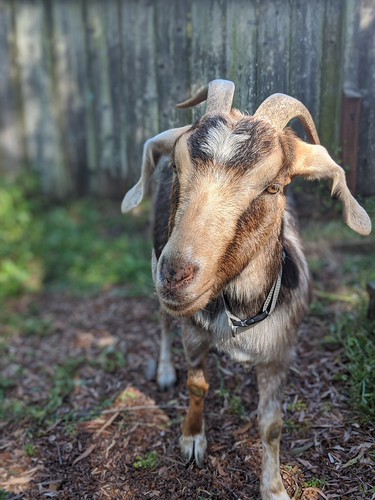
Emma is topologically unfeasible.

I love them with every particle of my being.
Posted in adventure time, happiness, hope, i love the whole world, little gorgeous things, san francisco | Comments Off on adventure time: landscaping crew
He shewed me a little thing, the quantity of an hazel-nut, in the palm of my hand; and it was as round as a ball. I looked thereupon with eye of my understanding, and thought: What may this be? And it was answered generally thus: It is all that is made.
Posted in bookmaggot, mindfulness | Comments Off on revelations of divine love, by julian of norwich
Everyone’s adventures are appropriately downscaled right now, but our neighborhood is a half mile south-east of where it used to be, and we’re exploring fresh walks. We are now only a couple of blocks away from the beautiful Alemany Farm, with its orchards and running brook and frog pond:

Just up the hill to the west of us are the Harry Street Stairs:

Which lead through fairy meadows:

To the Miguel Street Mural.

Grocery shopping right now feels stressful and unhappy, but walking around the neighborhood at Golden Hour feels like a treat. Everyone is respectful and keeps their distance. We smile and nod at one another, and say: “Stay safe.”
Posted in adventure time, hope, little gorgeous things, san francisco | Comments Off on adventure time: neighborhood walks
Afterward, I would mourn her as if she’d died, because something had: someone we had created together
How to read her coldness: She is preoccupied. She is unhappy. She is unhappy with you. You did something and now she’s unhappy, and you need to find out what it is so she will stop being unhappy. You talk to her. You are clear. You think you are clear. You say what you are thinking and you say it after thinking a lot, and yet when she repeats what you’ve said back to you nothing makes sense. Did you say that? Really? You can’t remember saying that or even thinking it, and yet she is letting you know that it was said, and you definitely meant it that way.
Your body is brilliant, even when you are not. It doesn’t just heal—it learns. It remembers. (All of this, of course, if the virus doesn’t kill you first.)
Posted in bookmaggot, grief, the end of all things, women are human | Comments Off on in the dream house, by carmen maria machado
Last Thursday, Jeremy asked what it would take for us to decide to cancel or postpone our planned trip to Australia. On Monday, we rescheduled our flights. Yesterday, the public schools and our kids’ school all closed. In grocery stores, people are calm and brave, Londoners during the blitz. Online, we take turns being scared and comforting one another.
I’m sitting on my back deck drinking coffee with Jeremy. The gardens are full of birdsong. Hummingbirds are having fierce air battles over the shrubbery. And now I know why the pair of crows I’ve been trying to befriend have been so preoccupied. They’re building a nest.
Posted in history, little gorgeous things, mindfulness, san francisco | Comments Off on well, that escalated quickly
It feels like all four of us have let out a collective breath. The kids were champions during the long wait to move in, and instantly happier after the move. They assembled their own IKEA beds. We have dinner at the dinner table, like dinner-having people. During a brief spat earlier, the big kid said: “Fine. I’ll go to my room,” and she did, and it was glorious.
Children can have little a personal space, as a treat.
Posted in children, san francisco, they crack me up | Comments Off on that feeling when you live in an house
…is how long we lived in the apartment on Eugenia Avenue. On Monday we moved again, into a house half a mile up the road. The neighborhood is called College Hill. No one has ever heard of it. I say it’s still part of Bernal Heights, but the kids insist it’s Glen Park.
It’s two years since we bought this place. It was a very sweet Queen Anne with just a little deferred maintenance (termites, wood-boring beetles, asbestos, a mummified cat in the walls), waiting for a naive tech couple to come along and pour their life savings into it. There are a lotta construction photos, if that’s your jam. Our architect and general contractor are both local, women-owned businesses, and they did such a good job, I can’t even tell you, you would fall off your horse. My Fireclay tiles, let me show you them.
Tonight’s our second night here. I’m hoping to make friends with the crows, but they were distracted today with yelling at a redtail hawk. There’s a toyon full of hummingbirds. Our neighbor Lucinda brought around a basket of Meyer lemons from her tree with a note that said: “Welcome home.”
Posted in adventure time, happiness, san francisco | Comments Off on sixteen years and one month
“You were an orphan?” Stephen frowned. “I’m so sorry.” “Almost everyone is, eventually,” said Grace. “It’s not a big deal.”
Posted in bookmaggot | Comments Off on paladin’s grace, by t. kingfisher
I had my first existential crisis when I realized that it was not possible to have a pony in the city.
Posted in bookmaggot | Comments Off on farm city, by novella carpenter
Such is the inconvenient truth of globalization: it is based more on market sleight of hand than on Adam Smith’s invisible hand.
Posted in bookmaggot | Comments Off on the outlaw ocean, by ian urbina
…the real disaster is everyday life, which alienates us from each other and from the protective impulse that we harbor.
Posted in bookmaggot | Comments Off on how to do nothing, by jenny odell
…there is no escape and nowhere to run. There is no outside capitalism anymore. Capitalism has contacted all of our tribes.
Posted in bookmaggot, ranty, san francisco, women are human | Comments Off on initiated, by amanda yates garcia
When I think of my father, I think of my heart breaking in stages.
Posted in bookmaggot, grief | Comments Off on long live the tribe of fatherless girls, by t kira madden
Doctors found, paradoxically, that the people most prone to this type of anxiety were not the active combatants, who were out on the street and had a sense of agency, but the women and children stuck sheltering behind closed doors.
Posted in bookmaggot, grief, ireland, politics, women are human | Comments Off on say nothing, by patrick radden keefe
You cannot write out of someone else’s dark place; you can only write out of your own.
Posted in bookmaggot, grief, hope, ranty, san francisco, women are human | Comments Off on know my name, by chanel miller
The hills of Montgomery Pass had seven permanent springs. Though the region comprises more than 100,000 acres, the springs, when combined, would maybe cover only a single acre. Nearly all of the region’s wildlife had to pass through this tiny bottleneck. That is where the lions waited.
Posted in bookmaggot, horses are pretty | Comments Off on wild horse country, by david philipps
© 2009 “Yatima” · Powered by Wordpress and Bering Theme 2026