london falling, by patrick radden keefe
Wednesday, September 9th, 2026
London is such a beautiful place that it can be easy, as you stroll around the city, to forget that much of it was built on imperial plunder.
London is such a beautiful place that it can be easy, as you stroll around the city, to forget that much of it was built on imperial plunder.
One wing of the British Museum, in a crowd in a heatwave while jetlagged, but I did get to see Lindow Man (an ancestor), the Sutton Hoo ship burial and the Lewis chessmen. One wing of the V&A on a cooler day and lunch with a friend in the spectacular cafe, the first museum cafe ever, what a good innovation. A bookshop in Notting Hill; no, not that one, the other one. Bike rides to Westminster and Chelsea. The Chelsea Physic Garden with a glass of Pimm’s and another friend: you are my medicine.
Our rental car: an electric blue Mini Cooper. Avebury henge, even more beautiful than I imagined it, with a gratuitous game of cricket off to one side. The warm surface of the stones, so large, so lichen-y: more ancestors. Oak trees in golden grasslands like it’s freakin’ West Sonoma county out here. Cheshire at golden hour, with hares grazing among the sheep and cattle in the hayfields. Reading Elizabeth Gaskell, Barbara Pym, Elizabeth Taylor (not that one, the other one), Virginia Woolf. A Hendricks and tonic under a tree at the Cholmondeley Arms. A walk around the Roman walls of Chester. Jodrell Bank, peering out at the cosmic microwave radiation: another ancestor.
Although Britain has yet to produce the quantities of superb art found on the continent, there are one or two examples of carving on bone, ivory and stone. My personal favourite is a very confident yet delicately executed horse’s head on a fragment of horse rib, found in a cave at Creswell Crags, Derbyshire.
She considered other writers aloofly. “Shakespeare,” she said reluctantly. “Perhaps Goethe,” she added, using a pronunciation of her own.
The Major had told him one day that in five years’ time no one would read any more. Later, archaeologists would ponder on, argue about, what books had been for. ‘It’ll all be telly; visual aids.’ ‘Then why are more books published every year?’
Seldom penetrated by love for mankind as I am, I sometimes feel sorry for the poor who don’t read Shakespeare
Did people then only go for the light and warmth, the coffee after the Sunday morning service and a friendly word from the vicar?
English, which had started out as a language of the oppressed, had become an oppressor.
Were there schools? A few, to train servants of the empire.
I sometimes wonder if all those English country gentlemen who built themselves big houses with long sightlines and high walls did it because they were afraid of people coming across the seas for vengeance. I hope they were terrified.
You can never make that crossing that she made, for such Great Voyages in this world do not any more exist. But every day of your lives the miles that voyage between that place and this one you cross. Every day. You understand me? In you that journey is.
Having traced my mother’s family to the Kingdom of Mercia I am in gales of laughter over the title of the most important surviving text in the Mercian language: The Old English Martyrology. Even other people who knew my mother and grandmother don’t think it’s as funny as I do. Story of my life.
Baggage means no matter how far you go, no matter how many times you immigrate, there are countries in you you’ll never leave.
I’m sad she’s dead, for the usual human and parasocial reasons.
I’m genuinely curious if also worried about what comes next.
And I’m angry, I am so so angry, about the British empire.
As a white Australian I exist because of what Britain saw as surplus population it could send to administer its stolen wealth. The ways in which my life was predetermined, the ways in which I was raised and educated to be a colonial bureaucrat, were callous and calculating and fundamentally genocidal, and have left me traumatized.
The thing about Elizabeth. The thing! That I managed to grope towards just now, is that she was a human sacrifice to empire. She had no choice and no escape. She had to do her duty.
And she did her duty flawlessly. She was incredible at it. A genuinely awe-inspiring triumph of will.
And she shouldn’t have done that. For two reasons. One (the most important) is because the Empire is a death cult that murdered millions on her watch. The other is that her performance of that duty is and always will be forced on the rest of us as the standard we will inevitably fail to meet.
I admire her. But I will not seek to emulate her. Her indulgence of powerful men and her racism were ruinous even in her immediate family, and catastrophic for the world. What she did so amazingly well is a thing that should never have been done.
Which loops back to sorrow. Those glimpses of the woman she could’ve been: the 18yo ambulance driver, the rider galloping her own racehorse.
What a fucking waste and betrayal of all her strength and integrity, to pour it out in the service of maintaining a corrupt status quo.
What a waste of mine.
I realized just before our flight that we would be landing half way through the matinee for which we had tickets; proof if proof were needed of just how badly I needed a break. I called Grant and woke him at 1am to explain, and somehow by the time we landed he had cajoled the theatre into exchanging our cheap-ass matinee tickets for tickets to the evening performance. Grant’s impossible to describe. He’d be one of my favourite people on earth even if he hadn’t introduced me to Jeremy; as it is, he is responsible for most of the great joys of my life.
Our hotel was a stone’s throw from St Pancras. Grant met us there and took us to one of the restaurants on Battlebridge Place, the newly developed expanse of public space between St Pancras and Kings Cross. Miss Jo came to meet us and so did Kirsty, so there I sat in the warm evening with my kids and some of my dearest friends, my Mardi-Gras-and-Burning-Man-crossover friends, bewilderingly happy. Kirsty and her friend Sacha joined us for the show, Lin-Manuel’s other musical, In the Heights; great fun.
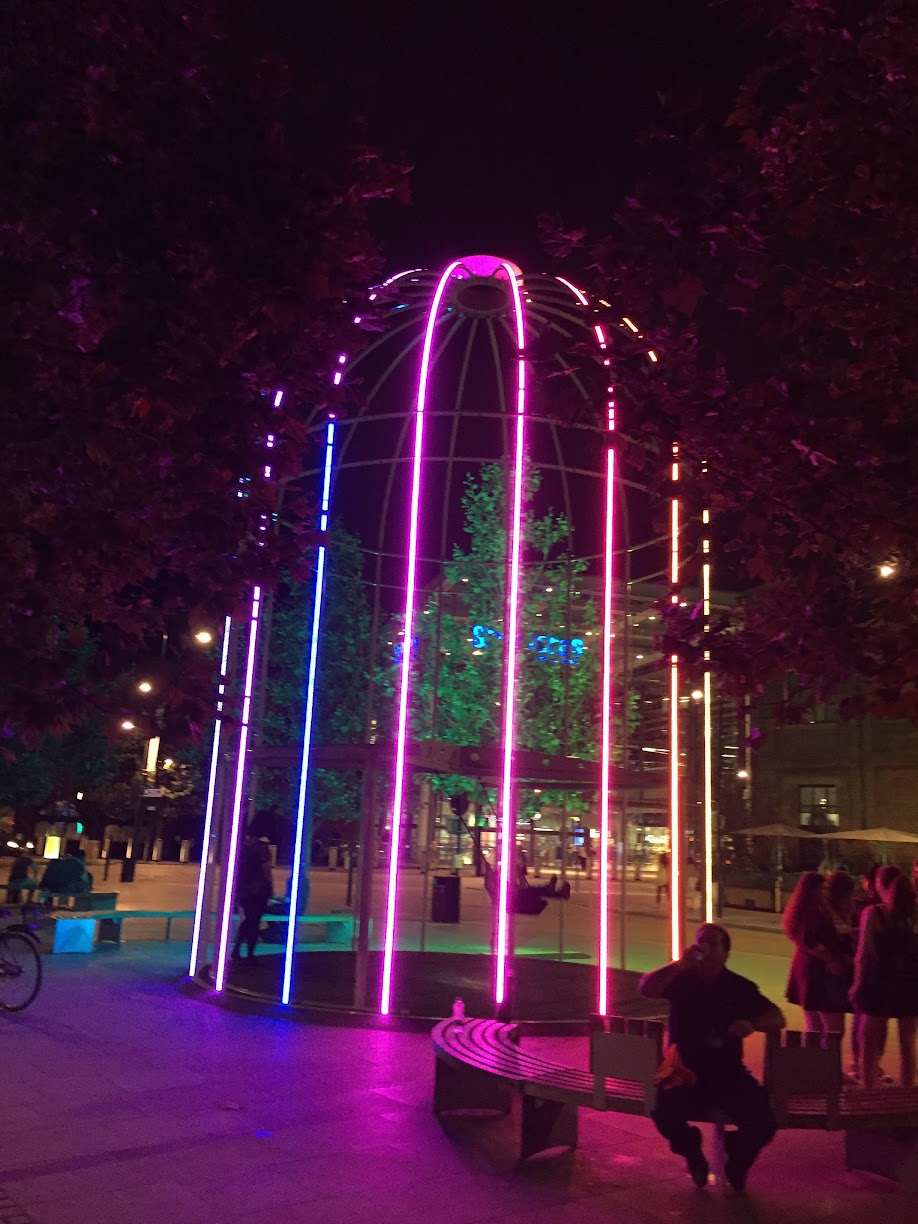
As we walked back to our hotel we stopped at the large birdcage covered in rainbow LEDs, and Julia swung on the swing inside.
The next morning we hit in quick succession the British Library Reading Room (pages from Leonardo’s journals, the Magna Carta, Jane Austen’s writing desk and Persuasion in her handwriting), the Wellcome Collection (Napoleon’s toothbrush) and – our overwhelming favourite – the Grant Museum of Zoology, with its quagga and thylacine skeletons and its dodo bones.
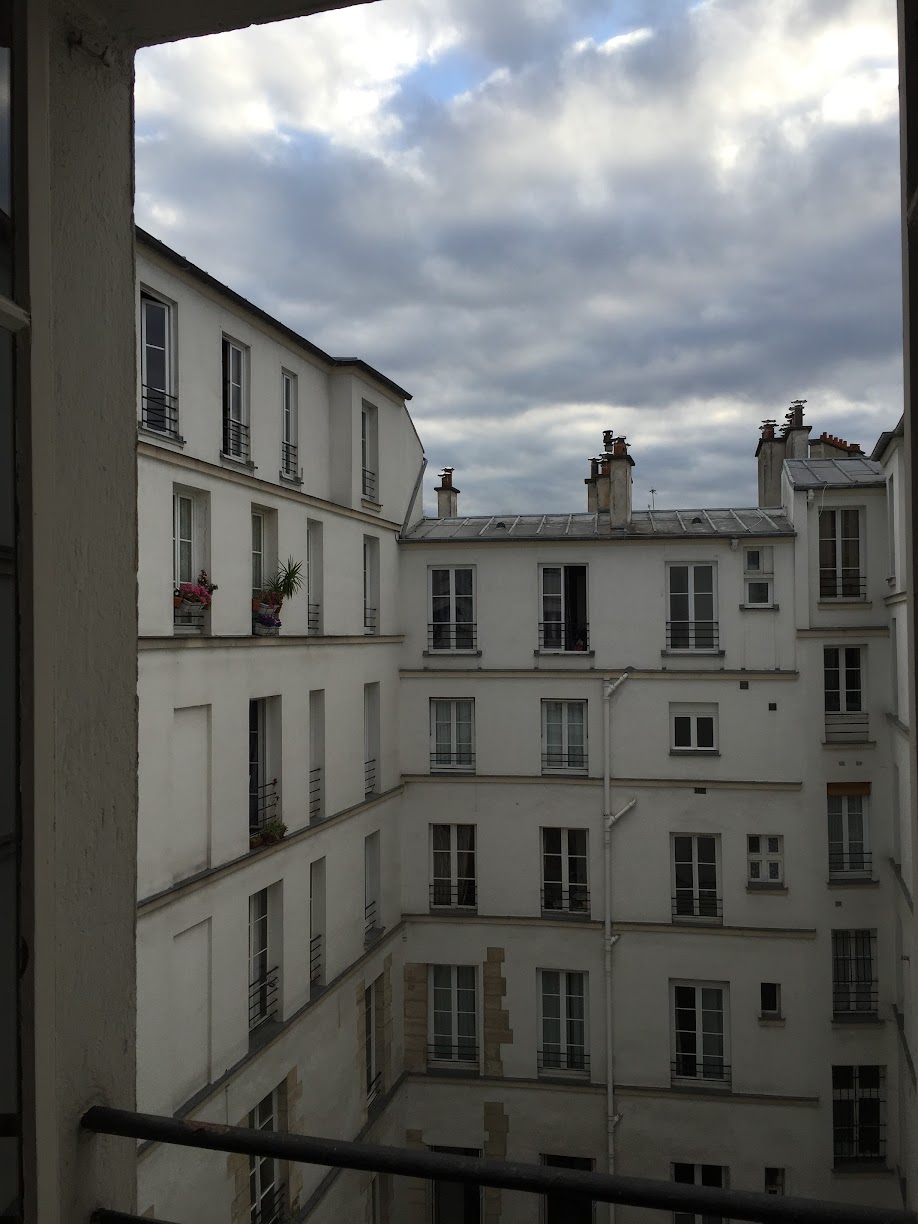
Still jetlagged, I dozed off on the Eurostar and woke having no idea what country I was in; southern England looks a lot like Northern France. I had slept through the Channel tunnel! Arriving in Paris by train is infinitely preferable to flying in. We took the Metro from Gare du Nord and walked from Odeon to our apartment.
We travel like such nerds. Picking up where we left off last year in the Louvre, I noticed myself noticing things. Last year, feeling crosser, I was outraged at the self-congratulatory imperialism of places like the British Library and the Louvre. This year, humbler and more grateful, I thought: Yes, and; England and France robbed the world but in their museums, we-the-colonised can look at the things once kept only for our foreign kings. I love palaces made over into public spaces. I love the children in the Grant squealing over the jar of moles, and the black women among the Egyptian antiquities, their hair in cornrows exactly like the people in the friezes.
Best capstone to a trilogy that, unbelievably, saw my OT3 made canon: Ancillary Mercy
Ann Leckie’s Imperial Radch series explores oppression both overt and covert, personhood and autonomy, cruelty and choice. It is also and very intimately about love and trauma and about the slow and painful process of recovering from having been used as a weapon. It is difficult and allusive and strange and I have seldom loved a story more.
Best memoir containing descriptions of the surface of living human brains: Do No Harm: Stories of Life, Death, and Brain Surgery
A few years ago Jeremy and I saw The English Surgeon, a beautiful documentary about Henry Marsh, and this book of his is an extraordinary complement, the effect of which is to make both texts deeper and richer. You walk away from the film thinking that Marsh is some kind of genius angel. The book is all about his fear, doubt and failures, failures that led to the deaths of patients he loved.
Best inspiration for a hit Broadway musical: Alexander Hamilton
Ron Chernow’s biography of the Founding Father is fantastic in its own right, but looking at how Lin-Manuel Miranda manipulated the timeline and even the construction of some of the main characters is a master class in creative transformation.
Best book whose first chapter will make you ugly-cry into your latte at Cafe St Jorge, to the mild alarm of your fellow guests: Voices from Chernobyl: The Oral History of a Nuclear Disaster
Svetlana Alexievich won the Nobel Prize this year but be warned: her stories about what actually happened in the aftermath of the explosion, and how social class dictated who suffered and who died, will fuck you right up.
Best and most moving farewell from a writer you have loved all your adult life: On the Move: A Life
What can I add to what has already been written about Oliver Sacks, his imaginative compassion, the generosity of spirit that grew so unexpectedly out of his privileged and circumscribed circumstances? Not much. (In close second place for this category: Clive James’ Cultural Amnesia.)
Best gift for your girlfriends of the crazy cat persuasion: The Dead Ladies Project: Exiles, Expats, and Ex-Countries
Disappointed in love, the brilliant Jessa Crispin packed up her apartment and couch-surfed her way across Europe, reading in search of reasons to go on living. A manifesto for all of us who are lost, lonely and ugly, outside and in.
Best book you bounced off hard as a stupid kid and now recognize for the straight-up masterpiece it is: Beloved
The insane, vindictive ghost baby? It’s us.
Best book-length elaboration on the theme that Black Lives Matter: Between the World and Me
Ta-Nehisi Coates’ open letter to his son may also turn out to be an enduring masterpiece, but for me the most intimate pleasure of it was its celebration of Paris, a city that for all its fucked-up flaws is one of the finest things human hands have made.
Best book that killed off my favorite character from the previous book in its opening scene: The Philosopher Kings
Jesus, Jo! This series is obviously written for the pure motherfucking joy of it, for the wish-fulfillment of standing shoulder to shoulder with the writers you adored and building a city even more beautiful than Paris. (And then finding out that you had overlooked some very important questions about personhood, autonomy, cruelty and choice.)
Most heartbreaking memorial to our own lost generation: And the Band Played On: Politics, People, and the AIDS Epidemic
An essential book and a companion to the equally essential The Gentrification of the Mind: Witness to a Lost Imagination, Randy Shilts’ history of the plague documents the appalling cost of it and the sheer inadequacy of our human response.
Most beautiful portrayal of raw grief: Men We Reaped
Five young men close to Jesmyn Ward died in four years, and this devastating meditation on their deaths brings their loss into razor-sharp focus.
Most accurate portrayal of Australia as an airless mining asteroid that turns men’s hearts to stone: This House of Grief
Helen Garner is our Janet Malcolm and this book is our Iphigenia in Forest Hills.
By the numbers:
Books by women: 7. People of color: 3. Gay men: 2. Straight white men: 2. (Is this the most charming sentence in Wikipedia? “Marsh is married to the social anthropologist Kate Fox and spends his spare time making furniture and keeping bees.” Kate Fox wrote Watching the English! BEST DINNER PARTY GUESTS.) I used to joke that I didn’t read books by straight white men because their concerns were too narrow and parochial, but it’s not a joke any more.
Australian writers: 1. Russian: 1. English: 3ish, although Jo Walton is Welsh and lives in Canada and Oliver Sacks spent most of his life in New York. American: 7.
Total books read: about 120. Either I am slowing down or I lose 30 books’ worth of capacity in each year in which one of my parents dies. Guess we’ll find out!
“I can hear people singing,” (and since I’m not allowed to listen to this playlist until after Thanksgiving) “it must be” Northern Hemisphere Midwinter Festival “Time.” Chrissie Hynde wrote this after The Pretenders’ first lead guitarist James Honeyman-Scott died of an overdose; as you’ll see, I like the sad carols. The ending of this song is sublimely 1980s; the band just repeats the chorus over and over until they end on a resounding chord. Jazz hands!
So much for being nondenominational: because I’m a lapsed Anglican nerd, I sometimes wonder whether Jonathan Coulton (suspicious initials, those) named his protagonists the Andersons because it means “Son of Man” and whether he chose Chiron because Chi-Rho was a Greek monogram for Christ. That said, the song works equally well as an anticapitalist anthem, with the robot overlords representing limited liability corporations. Oh, and it’s hilarious.
Mandatory, obvi. I usually start crying around “I could’ve been someone./ Well so could anyone.” Reminds me of when Rajit Singh returned our lost luggage and, years before that, when I met Shane MacGowan in Dublin, his broken teeth like tombstones on the red hills of his gums. I wish Kirsty MacColl were still alive.
This one makes me think of Jamey, who gave it to me, and of my mum, whose story it is. Tracey Thorn’s voice is a silver thread running through my marriage, from “Protection” as the anthem of our first year together to “Hatfield, 1980” for the summer we lived in Cambridge. Mum would have loved the lines: “We face down all the coming years/ And all that they destroy/ And in their face we throw our joy.” That was her basic rationale for all the mah jongg and Bailey’s.
Tracey’s Tinsel and Lights is such a great album that three tracks off it have landed on my playlist. This is a Joni Mitchell cover that earned its place for the lyrics: “I’m so hard to handle/ I’m selfish and I’m sad.” (No, YOU are.) I always think of Emma Thompson’s wonderful line from the mostly-reprehensible Love, Actually: “Joni Mitchell is the woman who taught your cold English wife how to feel.”
A Sufjan Stevens cover, but I heard Tracey’s version first so it’s definitive to me. I love the strangeness and sensuality of the lyrics – “I kissed your ankle” – and Sister Winter as darkness and heartbreak, but also as an intimate relation. I love the friends waiting patiently for the suffering heart to recover. Demeter and Persephone are here, and so is Jonathan Shay’s Odysseus in America with its call for the communalization of trauma.
Speaking of, that summer in Cambridge I wanted to hear the King’s College choir at last, but I was urged by a smiling Anglican to keep the girls behind the screen where we wouldn’t disturb the other congregants. Ah, the established church, ever eager to tuck its women and children away out of sight. Against that, though, set the pageant I attended at Holy Innocents in San Francisco, where the congregation discovered six-week-old Julia in her sling and urged me to take the role of Mary. I declined – I’m not that reconciled to my church damage – but I still have the tinsel crown Claire wore as a three-year-old angel. This strange old poem was given a mid-20thc setting by Elizabeth Poston. “It keeps my dying faith alive” – we’ll see, I guess.
Another silver thread through my life: My parents playing Steeleye Span when I was still too young to recognize the electric guitars and folk songs as incongruous with one another. Me carolling in York Street with the choir of Christchurch St Lawrence. Alex and I in Dublin discovering that we both loved this song. Maddy Pryor’s incredible voice was probably the prototype for my love for Kirsty Maccoll, Tracey Thorn and Vienna Teng. The ending of this song is ridiculously 1970s; the audio engineer just fades the choir out and you have to pretend that they’re walking away from you still singing.
This one makes me think of Salome, because sometimes we read each others’ minds. Talk about incongruity, the ukuleles and xylophones making it sound like a school play. Yet everything that makes the Northern Hemisphere Midwinter Festival important to me is here: the long dark, the beloved dead, the newborn baby, the terrifying angels and their incomprehensible message. The star and our journey.
The newest addition, which I heard for the first time live on Boxing Day last year at the Freight & Salvage, with Claire in my arms. I gave this one to Tina after we rode our bikes to the Forest of Wind Chimes at Wilbur Hot Springs and cried for Jen. “It’s the season of bowing our heads in the wind/ And knowing we are not alone in fear/ Not alone in the dark.” That’s all I got. Grace coming out of the void, for some reason. It’s so cold now but spring will come again. Not a metaphor: physics.
We’re back in the first person. Wilmet, the narrator of Glass, is the smuggest and most unpleasant of Pym’s heroines. I should confess to my own feelings of unpleasant smugness when she gets her (surprisingly progressive) comeuppance.
I’m hugely enjoying the continuity in the Pym universe. Wilmet is Archdeacon Hoccleve’s distant cousin. She and her friend Rowena knew Rocky Napier in Italy, and Wilmet’s husband Rodney has a dalliance with Prudence. Best of all, Rowena reads to Wilmet out of a magazine, and what she reads is Catherine Oliphant’s fictionalized account of the moussaka scene.
But the weirdest moment by far in Glass is when *I* show up in it.
I thought he might be a colonial, perhaps a New Zealander. I remembered clever moody passionate girls, like Katherine Mansfield, striving to break away from the narrowness of their environment, almost nineteenth century Russian in their yearnings, hating the traditional English Christmas in the middle of summer and the sentimental attitude toward the Mother Country.
Since women like me are represented in English literature with considerably less frequency than most breeds of dog, it always comes as a bit of a shock.
Austen parallel: Mansfield Park. (It’s “about ordination.”)
Dulcie, the protagonist of Fond, is a tragic figure because she lives in a world without Google. Her ability to Googlestalk before the fact is both impressive and creepy. She gets one of the best proposal-rejection scenes so far. I was starting to think that this novel took place outside the Pymiverse until Dulcie ran into Wilmet at a castle.
Austen parallel: Dulcie thinks she’s in Persuasion, but I think she’s in Northanger Abbey.
This marks the break in Pym’s career. She was bumped off the midlist after Fond and didn’t get anything published for another eighteen years. A good time for me to take a break too, I think.
Sexy, independent Catherine Oliphant is the best Pym heroine so far. No frustrated literary yearnings for her: she writes romantic fiction for women’s magazines. Even as she catches her beloved in the act of having an intimate dinner with her replacement, she thinks to herself that their moussaka will be getting cold. She chooses her next crush on the basis of his resemblance to an Easter Island statue. I adore her.
The church takes a step back in this book and the vacuum is filled by anthropology. The resulting shabby-intellectual milieu is surprisingly reminiscent of Iris Murdoch.